
Construction Accident Lawyer Phoenix, AZ
If you were hurt on a construction site in Phoenix, you’ve probably already heard about workers’ compensation. However, you may be entitled to additional compensation.
Construction sites involve multiple employers, subcontractors, property owners, equipment manufacturers, and other parties working in the same space. When an accident happens, the negligence often belongs to someone other than your direct employer. Third parties can be held accountable through a personal injury or wrongful death claim, separate from and in addition to any workers’ comp benefits you may receive.
Our Phoenix, AZ construction accident lawyer at Wyatt Injury Law represents injured construction workers throughout the Phoenix area. Founding attorney Justin L. Wyatt has spent over 10 years handling serious injury claims in Arizona and has never represented an insurance company or defendant.
Why Choose Wyatt Injury Law for Construction Accident Cases in Phoenix, AZ?
Understanding the Full Scope of Liability
Our attorney thoroughly investigates injury claims. In construction cases, that means mapping every party involved in the project, including the general contractor, subcontractors, property owner, equipment suppliers, and design professionals, and evaluating each one’s potential liability. A $3,195,000 recovery in a sideswipe and construction defect case reflects exactly this approach: identifying all responsible parties and pursuing full accountability from each of them.
Our firm has recovered millions of dollars for injured clients across Arizona, including results across catastrophic injury, wrongful death, vehicle crashes, and premises liability cases. Construction accident cases frequently combine several of these categories, and we handle that complexity.
A Decade of Plaintiff-Side Practice in Arizona
Justin L. Wyatt graduated from Sandra Day O’Connor College of Law at Arizona State University and has practiced personal injury law in Phoenix for over 10 years, exclusively representing injured plaintiffs. He is admitted to all Arizona courts and the United States District Court for the District of Arizona, and is a member of the Arizona Association for Justice, the Maricopa County Bar Association, and the American Bar Association.
Construction accident cases in Arizona involve a specific intersection of workers’ compensation law, third-party liability, OSHA regulations, and premises liability statutes. Justin’s decade of practice in this jurisdiction means he understands how these frameworks interact and how to position a case to recover the maximum from every available source.
Recognition That Reflects Results
Justin earned a Top 10 Jury Verdict recognition from the National Trial Lawyers Association in 2021. That recognition tells a specific story: cases are prepared as if they will go to trial, and when settlement doesn’t reflect what a case is worth, trial is an option the firm has demonstrated willingness to use. Construction defendants and their insurers respond to that differently than they do to attorneys who settle everything.
⭐⭐⭐⭐⭐
“Justin Wyatt is a fantastic attorney. I’m originally from the valley but live in the Pacific NW. I have sent several clients to him for assistance and, without exception, they have praised Justin for the incredible work he did on their case.” — Travis Prestwich
Read more reviews on our Google Business Profile.
No Fee Unless We Win
All construction accident cases are handled on contingency. Our fee is a percentage of what we recover, paid at the end of your case. If we don’t win your claim, you owe nothing.
Types of Construction Accident Cases We Handle in Phoenix
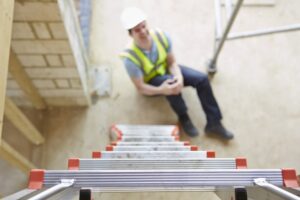 Construction accidents in Phoenix arise from a wide range of causes and involve many different types of injuries. We handle the following construction injury cases throughout Phoenix and Maricopa County.
- Falls from heights. Falls are the leading cause of construction fatalities nationally. Scaffolding collapses, ladder failures, unguarded floor openings, and inadequate fall protection systems all create third-party liability beyond what workers’ comp addresses. When a fall results from a general contractor’s safety failures or defective equipment, a personal injury claim is often available.
- Caught-in and caught-between accidents. Workers caught in machinery, between equipment and structures, or crushed by moving vehicles on site suffer some of the most catastrophic injuries in any industry. These accidents frequently involve defective equipment or failure to implement required machine guarding, creating product liability or third-party negligence claims.
- Struck-by accidents. Falling objects, swinging equipment, and vehicles on active construction sites create serious struck-by injury exposure. When the hazard was created by another contractor’s work or a product failure, third-party liability may apply alongside workers’ comp.
- Scaffolding and ladder accidents. Defective scaffolding equipment, improper assembly, inadequate inspection, and failure to comply with OSHA scaffolding standards are among the most litigated construction accident causes. Both the scaffolding manufacturer and the party responsible for installation and inspection may bear liability.
- Electrical accidents. Electrocution is the fourth leading cause of construction fatalities in the United States. Exposed wiring, improper lockout/tagout procedures, contact with overhead power lines, and defective electrical equipment all create injury and wrongful death exposure. Utility companies and electrical subcontractors may bear separate liability.
- Burn injuries. Explosions, electrical arc flash, chemical exposure, and fires on construction sites produce severe burn injuries requiring specialized medical care and often resulting in permanent disfigurement. Third-party liability frequently exists when safety protocols are ignored or equipment fails due to negligent maintenance or defective parts.
- Wrongful death construction accidents. Families who have lost a construction worker because of another party’s negligence have rights beyond the workers’ compensation system. Arizona’s wrongful death statute provides a path to full accountability, including non-economic damages for grief, loss of companionship, and loss of support that workers’ comp does not cover.
- Trench and excavation collapses. Trenching and excavation work carries some of the highest fatality rates in construction. OSHA requires protective systems for excavations over five feet, and violations of those requirements that cause injury create clear third-party liability.
- Defective construction equipment. When a crane, forklift, power tool, safety harness, or other equipment fails due to a manufacturing or design defect, the manufacturer and distributor may be liable under product liability law, separate from any negligence claim against the contractor or site owner.
- Construction vehicle accidents. Forklifts, dump trucks, cranes, and other heavy equipment operating on and around Phoenix construction sites create collision exposure for both workers and members of the public. These cases often involve both workers’ comp and third-party liability claims.
Arizona Legal Requirements for Construction Accident Claims
Workers’ Compensation and Third-Party Claims. Arizona requires most employers to carry workers’ compensation insurance under A.R.S. § 23-901 et seq. Workers’ comp provides medical benefits and wage replacement regardless of fault, but it does not cover pain and suffering, full lost earning capacity, or non-economic damages. Critically, workers’ comp does not prevent a separate personal injury claim against a negligent third party such as a subcontractor, equipment manufacturer, property owner, or general contractor who is not your direct employer. Pursuing both simultaneously is often the right strategy and is permitted under Arizona law.
OSHA Construction Standards, 29 CFR Part 1926. The Occupational Safety and Health Administration’s construction industry standards under 29 CFR Part 1926 govern fall protection, scaffolding, trenching, electrical safety, and dozens of other site conditions. An OSHA violation that causes injury constitutes strong evidence of negligence, and in some circumstances, negligence per se. OSHA investigation records and citations are valuable evidence in construction accident claims.
Arizona Division of Occupational Safety and Health (ADOSH). For construction sites not covered by federal OSHA jurisdiction, the Arizona Division of Occupational Safety and Health enforces state workplace safety standards. ADOSH citations and investigation findings can play the same evidentiary role in a construction accident claim as federal OSHA records.
Premises Liability. Property owners have a duty to maintain reasonably safe conditions on their land. When a construction site is on privately owned property and the owner’s negligent maintenance or failure to warn contributed to the accident, a premises liability claim may exist against the property owner separate from claims against contractors.
Statute of Limitations, A.R.S. § 12-542. Personal injury claims arising from construction accidents must be filed within two years of the date of injury. Wrongful death claims run two years from the date of death. Government entity involvement triggers a 180-day pre-suit notice requirement under A.R.S. § 12-821.01. The Arizona statute of limitations is a hard deadline. The full statute is at A.R.S. § 12-542. Construction accident cases often involve extensive investigation, so do not wait to consult an attorney.
Comparative Fault, A.R.S. § 12-2505. Arizona’s pure comparative fault rule applies to third-party construction accident claims. Your recovery is reduced by your percentage of fault, but there is no threshold that eliminates your right to recover. The statute is at A.R.S. § 12-2505.
What Damages Are Recoverable in a Phoenix Construction Accident Case?
Workers’ compensation and third-party claims provide fundamentally different types of recovery. Understanding the distinction matters because it determines what you’re actually entitled to receive.
Workers’ comp covers your medical treatment and replaces a portion of your lost wages, typically around two-thirds of your average weekly wage up to a statutory maximum. It does not require you to prove anyone was at fault, which is its primary advantage. However, workers’ comp does not compensate you for pain, for the permanent limitations your injury imposes, for the career you can no longer pursue, or for the life you had before the accident.
A third-party claim fills that gap. When a party other than your employer caused your injury through negligence, you can pursue the full range of damages available under Arizona personal injury law. That includes 100% of your lost wages rather than the two-thirds cap, the difference in earning capacity over your remaining working life if the injury is permanent, and all future medical costs rather than just treatment approved by a workers’ comp insurer. It also includes everything workers’ comp ignores: pain and suffering, disfigurement from burns or amputations, emotional distress, and the fundamental change in how you experience daily life.
In cases where a contractor or property owner demonstrated conscious disregard for safety, such as ignoring documented OSHA violations or knowingly using defective equipment, punitive damages may also be available. These awards go beyond compensation and serve to punish conduct that puts workers at risk.
Arizona imposes no cap on compensatory damages in personal injury cases. For construction workers with permanent disabilities, spinal cord injuries, or traumatic brain injuries, the absence of that ceiling can mean the difference between adequate compensation and a lifetime of financial struggle. Catastrophic injury claims under Arizona law follow specific principles that affect how these damages are calculated and pursued.
What Steps Should I Take After a Construction Accident in Phoenix?

1. Get emergency medical attention immediately. Construction accidents frequently produce serious internal injuries, spinal trauma, and head injuries that aren’t fully apparent right away. Go to an emergency room, not an urgent care center.
2. Report the accident to your employer. Arizona workers’ compensation requires prompt reporting to preserve your benefits. Report the accident in writing as soon as you are physically able.
3. Request that your employer file a workers’ comp claim. Under Arizona law, your employer is required to file a workers’ compensation claim with their insurer. Keep copies of everything.
4. Document the scene as thoroughly as possible. Photographs of the accident location, the equipment or condition involved, any missing safety measures, warning signs or their absence, and your visible injuries. Construction sites change rapidly, so document before anything is moved or repaired.
5. Identify all parties on the job site. The general contractor, every subcontractor, the property owner, equipment suppliers, and any other parties present. The full liability picture depends on knowing who was responsible for what.
6. Preserve all physical evidence. Defective equipment, damaged safety gear, and any other physical evidence should not be discarded, repaired, or returned before it has been inspected and documented for your claim.
7. Request all official reports and records. OSHA or ADOSH investigation records, incident reports filed by your employer, medical records, and witness statements. These documents are foundational to a third-party claim.
8. Do not give a recorded statement to any insurer other than your own workers’ comp carrier. A third-party insurer is not on your side. Talk to an attorney before making any statement.
9. Be careful on social media. Any post suggesting physical activity inconsistent with your reported injuries can be used against you. Social media mistakes have damaged many injury claims.
10. Contact a Phoenix construction accident attorney immediately. Evidence on construction sites disappears fast. Safety conditions get remediated. Equipment gets returned or repaired. Early legal involvement protects your case and helps identify third-party claims that workers’ comp alone would never capture.
Construction Accident Statistics in Phoenix and Arizona
Phoenix’s construction boom has made it one of the most active building markets in the country, and one of the most dangerous for workers.
The Bureau of Labor Statistics Census of Fatal Occupational Injuries reports over 5,000 fatal work injuries nationally each year, with construction accounting for the highest absolute number of worker deaths of any industry. Falls, struck-by incidents, electrocutions, and caught-in accidents, the “Fatal Four” identified by OSHA, account for the majority of those deaths.
In Arizona, the Arizona Industrial Commission administers the workers’ compensation system and tracks workplace injuries statewide. Arizona’s construction industry employs hundreds of thousands of workers, with significant concentration in the Phoenix metro where residential, commercial, and infrastructure construction have all expanded substantially in recent years. More active projects mean more workers, more equipment, and more accident exposure.
The OSHA top-cited standards for construction show fall protection, scaffolding, and ladders among the most frequently cited violations nationally, patterns that appear consistently in Arizona inspections as well. These citations reflect systemic failures that cause real injuries on Phoenix-area job sites every year.
According to OSHA heat illness prevention guidance, construction workers are among the most vulnerable to heat-related illness, with outdoor fatalities disproportionately occurring in the first few days of working in hot conditions. Arizona’s extreme summer temperatures create serious and sometimes fatal exposure for workers who lack adequate rest, shade, and hydration.
The Arizona Department of Transportation oversees infrastructure projects throughout the Phoenix metro, including major freeway construction that employs thousands of workers annually on high-exposure job sites along the I-10, I-17, and Loop 101/202 corridors.
Phoenix Construction Accident Lawyer FAQs
 Can I sue a third party if I’m already receiving workers’ compensation?
 Can I sue a third party if I’m already receiving workers’ compensation?
Yes. Workers’ compensation and a third-party personal injury claim are entirely separate. Receiving workers’ comp benefits from your employer’s insurer does not prevent you from pursuing a claim against a negligent subcontractor, equipment manufacturer, property owner, or general contractor. In many construction accidents, the third-party claim is worth significantly more than workers’ comp provides.
What if my employer doesn’t have workers’ compensation insurance?
Arizona requires most employers to carry workers’ comp. If your employer is uninsured, the Arizona Industrial Commission administers a special fund for workers injured by uninsured employers. You may also have a direct negligence claim against your employer, something that is generally not available when workers’ comp coverage exists.
What is a “third party” in a construction accident case?
Any party whose negligence contributed to your accident who is not your direct employer. This includes the general contractor if they’re not your employer, subcontractors working on other phases of the project, the property owner, equipment manufacturers and distributors, and design professionals whose errors created the hazardous condition.
What OSHA violations are most common in Phoenix construction accidents?
Fall protection failures, scaffolding violations, lack of head protection, electrical hazards, and failure to implement required lockout/tagout procedures are among the most frequently cited. An OSHA citation for the condition that caused your accident is powerful evidence in a third-party negligence claim because it establishes that the hazard existed, that the responsible party knew or should have known, and that they failed to correct it.
Does it matter if I was partially at fault for the accident?
For workers’ comp, fault doesn’t matter and benefits are paid regardless. For a third-party personal injury claim, Arizona’s pure comparative fault rule under A.R.S. § 12-2505 applies. Your recovery is reduced by your percentage of fault, but there is no cutoff. Even if you contributed to your accident, you can still recover from negligent third parties.
What if the construction accident was caused by defective equipment?
A defective product, such as a crane with a faulty cable, a harness that failed under load, or a power tool with a design defect, gives rise to a product liability claim against the manufacturer, distributor, or seller separate from any negligence claims against the contractor or site owner. These claims do not require proving fault. They require showing the product was defective and caused the injury.
Can the general contractor be held liable for a subcontractor’s negligence?
Potentially yes. General contractors have a duty to maintain overall site safety and to ensure that subcontractors working on the project comply with applicable safety standards. When a general contractor knew or should have known about a dangerous condition created by a subcontractor and failed to correct it, they may bear liability alongside the subcontractor.
What if a government entity was involved in my construction accident?
If your accident occurred on a government-owned project or involved a government vehicle or employee, a pre-suit notice must be filed within 180 days under A.R.S. § 12-821.01. Missing it can eliminate your claim against the government defendant. Contact an attorney immediately if any government entity may have been involved.
How is pain and suffering calculated in a construction accident case?
Arizona has no fixed formula. Documented impact on daily life, physical function, psychological wellbeing, and relationships drives the value. In serious construction injuries such as amputations, spinal cord damage, or severe burns, non-economic damages can be substantial.
What if I was injured on a public road near a construction zone?
Construction zone accidents involving the traveling public, rather than workers, are handled differently. The general contractor, traffic control subcontractor, and potentially ADOT may bear liability depending on how the hazard was created and maintained. We handle both worker and public injury claims arising from Phoenix construction sites and zones.
How long does a construction accident case take?
Cases with clear third-party liability and documented injuries can resolve in one to two years. Multiple defendants, disputed liability, catastrophic injuries, or government entity involvement frequently extend timelines. The factors that commonly delay injury settlements are often present in construction cases.
What if my construction accident resulted in permanent disability?
Permanent disability claims involve future medical cost projections, vocational assessment of reduced earning capacity, and long-term pain and suffering calculations. These cases require more preparation and more support than standard injury claims. Evaluating what your settlement should actually cover is important when considering any offer.
What if I was a bystander injured near a construction site?
Members of the public injured by falling debris, construction vehicle accidents, or hazardous conditions near a Phoenix construction site have the same right to pursue a personal injury claim as injured workers, without the workers’ comp layer. The general contractor, subcontractor, and property owner may all bear liability depending on the facts.
How much does a construction accident attorney in Phoenix cost?
Nothing upfront. We work on contingency, meaning our fee is a percentage of what we recover, collected only when we win. If we don’t recover money for you, you owe nothing.
What should I do if my employer is pressuring me not to file a claim?
Your right to file a workers’ compensation claim and a third-party personal injury claim is protected by Arizona law. Retaliation against a worker for filing a workers’ compensation claim is illegal. Document any pressure or retaliation and contact an attorney immediately.
Most Dangerous Construction Sites and Zones in Phoenix
 Phoenix’s growth means active construction across the metro, and with it, consistent accident exposure in certain project types and locations.
High-rise residential and commercial construction in downtown Phoenix and the Camelback corridor involves significant fall hazard exposure, crane operations, and complex multi-contractor coordination that increases accident risk.
Infrastructure and freeway construction along the I-10, I-17, Loop 101, and Loop 202 corridors involves both worker injury exposure and public crash risk from construction zone traffic conflicts.
Residential subdivision development in west Phoenix, Goodyear, Buckeye, and the West Valley involves high volumes of framing, roofing, and electrical work with significant fall and electrocution exposure.
Commercial warehouse construction in the Southwest Phoenix industrial corridor has expanded rapidly, with large-footprint projects involving heavy equipment, steel erection, and concrete work at scale.
Important Local Resources for Phoenix Construction Accident Victims
The following resources may be useful after a construction accident in Phoenix. Their inclusion is for informational purposes only and does not constitute an endorsement by Wyatt Injury Law.
- Arizona Division of Occupational Safety and Health (ADOSH) – (602) 542-5795. State workplace safety enforcement, inspection records, and citation information for Arizona construction sites.
- Arizona Industrial Commission – (602) 542-4661. Administers Arizona’s workers’ compensation system, including claims for injured workers and uninsured employer situations.
- OSHA Phoenix Area Office – (602) 640-2007. Federal OSHA enforcement for construction sites under federal jurisdiction in the Phoenix area.
- St. Joseph’s Hospital and Medical Center – (602) 406-3000. Level I trauma center in central Phoenix with dedicated neurosurgical, orthopedic, and burn treatment capabilities.
- Banner University Medical Center Phoenix – (602) 747-4000. Level I trauma center serving the Phoenix metro with full trauma surgery capabilities.
- Maricopa County Superior Court – (602) 506-3204. For civil litigation filings and court information.
Wyatt Injury Law does not endorse and has no affiliation with any of the resources listed above. This information is provided as a public service.
Contact Wyatt Injury Law
Most construction accident victims are told workers’ compensation is their only option. In many cases, it isn’t. Third-party claims can recover what workers’ comp does not, including full lost wages, pain and suffering, and the complete scope of damages that a serious injury imposes over a lifetime.
Wyatt Injury Law represents injured construction workers throughout Phoenix and Maricopa County. We work on contingency, and we collect no fee unless we win your case. If you were hurt on a construction site, contact us for a free consultation. We will review the facts of your accident, identify every potential source of recovery, and provide an honest assessment of your options.