
Key Takeaways from a Phoenix Motorcycle Accident Lawyer
- Insurance adjusters carry real bias against riders. Motorcycle accident claims start at a disadvantage because adjusters tend to assume the rider was reckless or at fault. That assumption shapes initial offers and fault determinations from day one.
- Arizona’s helmet law doesn’t mean what insurers want you to think. Adults aren’t required to wear helmets under A.R.S. § 28-964, but insurers will still argue that not wearing one made your injuries worse. They’ll use comparative fault to reduce your payout.
- Lane filtering is legal, but the details matter. Arizona legalized lane filtering in 2022 under specific conditions. If your crash happened while filtering, your speed, positioning, and the traffic around you all factor into how fault gets assigned.
- The injuries are almost always more severe. Spinal cord damage, traumatic brain injuries, road rash requiring grafts, and amputations are common in serious motorcycle crashes on Phoenix corridors like I-10, the Loop 101, and Camelback Road.
- A Phoenix motorcycle accident lawyer at Wyatt Injury Law Personal Injury Lawyers is ready to fight for you. Call today for a free consultation.
Motorcycle Accident Lawyer Phoenix, AZ
If you’ve been hurt in a motorcycle crash in Phoenix, the legal fight ahead is harder for riders than it is for most injury victims. Insurance adjusters carry built-in bias against motorcyclists, with assumptions of recklessness and a tendency to blame the rider first.
Our Phoenix, AZ motorcycle accident lawyer at Wyatt Injury Law Personal Injury Lawyers has represented injured motorcycle riders throughout the Phoenix area for over 10 years. We handle everything from single-vehicle crashes caused by road defects to multi-vehicle collisions where fault is contested from the start. Founding attorney Justin L. Wyatt practices exclusively on behalf of injured plaintiffs and has never represented an insurer.
Why Choose Wyatt Injury Law Personal Injury Lawyers for Motorcycle Accident Cases in Phoenix, AZ?
Results Riders Can Point To
Our firm has recovered millions of dollars for injured clients throughout Arizona, including a $1,300,000 result in a  motorcycle injury case and a $200,000 recovery in a separate motorcycle collision. These aren’t flukes. They reflect what happens when a case is investigated thoroughly, valued honestly, and pursued without flinching when an insurer pushes back.
Justin L. Wyatt earned recognition as a Top 10 Jury Verdict recipient from the National Trial Lawyers Association in 2021. Insurance companies know the difference between an attorney who will try a case and one who won’t, and that reputation affects how they negotiate.
Deep Knowledge of Arizona Motorcycle Law
Justin graduated from Sandra Day O’Connor College of Law at Arizona State University and has practiced Arizona personal injury law for over a decade. He is admitted to all Arizona courts and the United States District Court for the District of Arizona. He is a member of the Arizona Association for Justice, the Maricopa County Bar Association, and the American Bar Association.
Motorcycle accident cases in Phoenix involve specific legal questions around Arizona helmet laws, lane filtering rules, how comparative fault is applied to rider conduct, and how to handle insurers who try to use a rider’s choice of gear against them. Justin understands how to navigate these issues because they come up in every serious motorcycle case.
Direct Attorney Involvement From Start to Finish
You’re not passed off to a case manager while your claim sits in a queue. Justin and our team handle each case with direct attorney involvement, communicate regularly with clients, and make sure people understand what’s happening and why. When decisions need to be made, whether to accept a settlement offer or whether to file suit, we explain the options clearly and honestly.
⭐⭐⭐⭐⭐
“Justin is an excellent attorney. I’ve been practicing law in Arizona since 2010. Anytime I need a referral for a personal injury case, without hesitation, I send clients to Justin.” — Matt Lopez
Read more reviews on our Google Business Profile.
No Fee Unless We Win
Our contingency fee structure means there’s no financial barrier to getting experienced legal representation after a motorcycle crash. We collect our fee, a percentage of the recovery, only when we win your case. If we don’t recover money for you, you owe nothing.
Types of Motorcycle Accident Cases We Handle in Phoenix
Motorcycle crashes take many forms. Some involve distracted or negligent drivers. Others involve dangerous road conditions or defective equipment. Whatever the cause, if someone else’s negligence contributed to your crash, you have legal options. We handle the full range of motorcycle injury cases throughout Phoenix and Maricopa County.
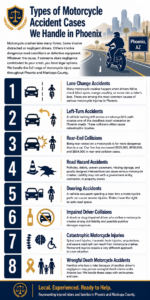
- Lane change accidents. The majority of multi-vehicle motorcycle crashes involve a driver who didn’t see the rider or claimed not to. Failure to check blind spots, improper lane changes, and merging into a rider’s lane are among the most common causes of serious motorcycle injury in Phoenix.
- Left-turn accidents. A vehicle making a left turn across a motorcyclist’s path is one of the deadliest accident types on Phoenix roads. These crashes often produce catastrophic injuries.
- Rear-end collisions. Being rear-ended on a motorcycle is far more dangerous than in a car. Our firm has recovered $525,000, $950,000, and $854,500 in rear-end collision cases, results that reflect the seriousness with which we approach high-impact rear-end claims.
- Road hazard accidents. Potholes, uneven pavement, debris, missing signage, and poorly designed intersections can all cause a motorcycle crash without another vehicle being involved. Depending on where the defect is located, liability may fall on a government entity, a contractor, or a property owner.
- Dooring accidents. A vehicle occupant opening a door into a motorcycle’s path is a serious and underreported cause of motorcycle injury in Phoenix. Riders have the right to safe road space.
- Impaired driver collisions. A drunk or drug-impaired driver who strikes a motorcycle creates both strong civil liability and potential punitive damages exposure. These cases are among the most straightforward on liability and among the most serious in terms of injury.
- Catastrophic motorcycle injuries. Spinal cord injuries, traumatic brain injuries, amputations, and severe road rash can result from motorcycle crashes. When injuries are permanent and life-altering, the damages involved require a completely different approach to case valuation.
- Wrongful death motorcycle accidents. Families who have lost a rider because of another driver’s negligence have the right to pursue wrongful death claims under Arizona law. We handle these cases with the seriousness and care they demand.
Phoenix Motorcycle Accident Infographic
Arizona Legal Requirements for Motorcycle Accident Claims
Several specific laws govern motorcycle operation and liability in Arizona. Understanding them matters to your case.
Helmet Law, A.R.S. § 28-964. Arizona does not have a universal motorcycle helmet law. Riders 18 and older are not required by Arizona law to wear a helmet. However, in a personal injury claim, an insurer may argue that a rider who wasn’t wearing a helmet assumed additional risk or contributed to the severity of their head injuries. Under Arizona’s pure comparative fault rule, this argument can reduce but cannot eliminate a rider’s recovery. The statute is available at A.R.S. § 28-964.
Motorcycle Equipment Requirements, A.R.S. § 28-964. Arizona law requires motorcycles to be equipped with specific safety features, including working mirrors, lights, and adequate brakes. Violations of equipment requirements by the at-fault driver’s vehicle can support a negligence per se argument.
Lane Filtering, A.R.S. § 28-904. Arizona legalized lane filtering in 2022, allowing motorcycles to filter between stopped vehicles under specific conditions. If your crash occurred in a lane filtering situation, the applicable law affects how fault is allocated. The Arizona Department of Transportation provides guidance on current Arizona traffic law, and the full statute is at A.R.S. § 28-904.
Comparative Fault, A.R.S. § 12-2505. Arizona’s pure comparative fault rule applies fully to motorcycle accident claims. Insurers use it aggressively against riders by arguing speeding, improper lane position, or gear choices as contributory fault. Every percentage of fault attributed to you reduces your recovery by that amount. The full statute is at A.R.S. § 12-2505.
Statute of Limitations, A.R.S. § 12-542. Two years from the date of the crash to file a personal injury claim in Arizona. Wrongful death claims run two years from the date of death. The statute of limitations is a hard deadline. Evidence disappears, witnesses’ memories fade, and missing the deadline eliminates your right to recover. The full statute is at A.R.S. § 12-542.
What Damages Are Recoverable in a Phoenix Motorcycle Accident Case?
A motorcycle crash doesn’t just injure your body. It disrupts your income, strains your relationships, and often changes what you’re able to do for years afterward. Arizona law recognizes all of these factors and allows recovery across three categories.
The financial losses come first in most cases.  Your emergency room visit, the ambulance ride, surgery if you needed it, and the specialists you’ll continue seeing for months. If the crash left you unable to return to your previous job, or any job, the difference in what you would have earned over your working life is recoverable. Your motorcycle, your gear, and anything else damaged in the crash factors in as well. For riders with permanent injuries, the projections for future care needs often represent the single largest component of the case.
But the bills only tell part of the story. The law also compensates for pain and suffering, which includes both physical pain and the psychological weight of recovery. Many motorcycle crash survivors experience anxiety, nightmares, or reluctance to ride again. The activities you enjoyed before the crash, whether riding, sports, or simply moving without pain, represent real losses. Arizona juries take these damages seriously when they’re documented well.
In cases involving egregious conduct, such as a drunk driver or someone racing on public roads, punitive damages may also apply. These are meant to punish reckless behavior rather than compensate for specific losses, and they can substantially increase a verdict or settlement when the facts support them.
Arizona places no cap on compensatory damages in personal injury cases. For motorcycle crashes involving permanent disability or long-term care needs, that matters enormously. If a pre-existing condition was aggravated by the crash, that doesn’t reduce what you’re owed. Arizona follows the eggshell plaintiff doctrine, meaning defendants are responsible for the full harm they caused.
What Steps Should I Take After a Motorcycle Accident in Phoenix?
1. Get to safety and call 911. If you’re able to move safely, get out of traffic. Call 911 regardless of how serious the crash appears because you need a police report and potentially medical assistance.
2. Seek emergency medical evaluation immediately. Adrenaline masks injury. Spinal injuries, internal bleeding, and traumatic brain injuries can be present without obvious symptoms in the immediate aftermath of a crash. Go to the emergency room.
3. Don’t remove gear at the scene. Your helmet, jacket, and gear may contain evidence relevant to crash dynamics and impact location. Let medical personnel manage it.
4. Document the scene thoroughly. Photos of all vehicles, your motorcycle, road conditions, skid marks, signage, weather, and visible injuries. The more documentation, the better.
5. Get all witness information. Names and phone numbers from anyone who saw the crash. Independent witnesses not connected to either party are particularly valuable in motorcycle cases where fault is contested.
6. Get the driver’s full information. Name, license, insurance carrier and policy number, vehicle registration. Photograph the other vehicle’s plates.
7. Request the police report. Follow up with Phoenix Police to obtain a copy as soon as it’s available. Review it for inaccuracies because errors in a police report can affect your case if not corrected early.
8. Do not give a recorded statement to the other driver’s insurer. They are not your insurer, and they are not on your side. Adjusters are trained to use early statements to establish contributory fault. Talk to an attorney before making any formal statement.
9. Preserve your motorcycle and gear. Do not repair, modify, or discard anything before your attorney has had the opportunity to document and inspect it. Your motorcycle is evidence.
10. Contact a Phoenix motorcycle accident attorney promptly. The earlier legal representation is in place, the better positioned your case is. Surveillance footage gets overwritten, physical evidence changes, and witnesses become harder to locate.
Motorcycle Accident Statistics in Phoenix and Arizona
The NHTSA motorcycle safety data reports that motorcyclists account for approximately 14% of all traffic fatalities nationally despite representing only about 3% of registered vehicles. In Arizona, that overrepresentation is even more pronounced. The state’s year-round riding season means riders are on the road every month, accumulating more exposure and more crashes than states where riding is seasonal.
The Arizona Department of Transportation crash data consistently shows Maricopa County as the location of the majority of Arizona’s motorcycle crash fatalities and serious injuries. Phoenix’s combination of high-speed arterials, dense freeway interchanges, and high distracted driver rates creates real exposure for riders at every level of experience.
Impaired driving is a persistent factor. The NHTSA impaired driving statistics show a significant percentage of fatal motorcycle crashes involve an impaired driver. In Phoenix, the density of nightlife along Central Avenue, Roosevelt Row, and Scottsdale Road contributes to late-night impaired driving exposure.
Intersection crashes remain among the most lethal for motorcyclists. Left-turn accidents, where a driver fails to yield to an oncoming rider, account for a disproportionate share of fatal motorcycle collisions in the Phoenix metro. The Governor’s Office of Highway Safety tracks speed-related fatalities statewide and has identified motorcycles as a priority concern in ongoing safety initiatives.
Phoenix Motorcycle Accident Lawyer FAQs
How is a motorcycle accident case different from a car accident case?
The injuries are typically more severe. The bias against riders from insurance adjusters is real and documented. And the legal questions around helmet use, lane filtering, and gear choices are specific to motorcycle cases in ways that car accident claims are not. An attorney who handles motorcycle cases regularly understands these dynamics.
What if the other driver claims they didn’t see me?
“I didn’t see the motorcycle” is the single most common defense in multi-vehicle motorcycle crashes. It is not a defense but rather a description of inattentive driving. A driver has a duty to observe the road, and failure to see a motorcycle that was lawfully present is negligence. We address this argument directly in every case where it comes up.
Does it matter that I wasn’t wearing a helmet?
Arizona does not require adult riders to wear helmets. But an insurer may argue that your head injuries were worse because you weren’t wearing one, and try to assign comparative fault. Under Arizona’s pure comparative fault rule, this could reduce your recovery but does not eliminate it. How much of a reduction, if any, is a factual and legal question we address in the context of your specific injuries and case.
Can I still recover if I was partially at fault for the crash?
Yes. Arizona follows pure comparative fault under A.R.S. § 12-2505. Your damages are reduced by your percentage of fault, but there is no cutoff. Even if you were found 40% at fault, you can still recover 60% of your total damages. Insurers will argue rider fault aggressively, which is why having an attorney who knows how to counter those arguments matters.
What if the driver who hit me has minimal insurance?
Arizona’s minimum liability coverage of $25,000 per person is often wholly inadequate for a serious motorcycle injury. Your own uninsured or underinsured motorist coverage may provide additional recovery. We investigate all available sources of compensation, including potential liability on third parties such as vehicle owners, employers, or road maintenance entities.
How long will my case take?
It depends on the complexity of the case and severity of injuries. Clear liability with well-documented injuries may resolve in six to twelve months. Disputed fault, catastrophic injuries, or litigation can take two years or more. We’re direct with every client about realistic timelines.
How much is my motorcycle accident case worth?
Every case is different. The key variables are the severity of injuries, total medical costs, lost income and future earning capacity, pain and suffering, and available insurance coverage. A reasonable settlement offer is a question we address honestly based on the specific facts of your situation.
What if my crash was caused by a road defect?
You may have a claim against a government entity, a city, county, or ADOT, depending on where the defect is located and who is responsible for maintenance. Claims against government entities in Arizona require a pre-suit notice filing within 180 days of the injury under A.R.S. § 12-821.01. Missing that window can eliminate your claim entirely, so if a road condition contributed to your crash, contact us immediately.
What if the at-fault driver was uninsured?
Your own uninsured motorist coverage applies in this situation. We evaluate every available coverage source in cases involving an uninsured or underinsured driver.
Do I need a police report to file a claim?
Not technically, but a police report is valuable evidence. It documents the scene, the parties involved, witness statements, and often an initial at-fault determination. If law enforcement did not respond to your crash, you can file a report with the Arizona Department of Transportation. We recommend it.
What if I was injured on a Phoenix freeway?
Freeway motorcycle crashes often involve higher speeds and more severe injuries. They also frequently involve multiple vehicles, complicating fault allocation. Traffic cameras on Phoenix freeways managed by ADOT can be critical evidence, and we pursue that footage early in every freeway crash case.
Can the motorcycle manufacturer be held liable?
If a defective part such as brakes, tires, throttle, or frame contributed to your crash or worsened your injuries, a product liability claim against the manufacturer may exist alongside your negligence claim against the driver. These cases require analysis of the motorcycle and the defect, and we evaluate product liability exposure in every case where equipment failure is a potential factor.
What is the most common injury in motorcycle accidents?
Road rash, fractures, and head trauma are the most frequent. In serious crashes, spinal cord injuries, traumatic brain injuries, and internal organ damage occur at rates far higher than in car accident cases. Catastrophic injuries that permanently alter the victim’s life are a significant portion of the serious motorcycle accident cases we handle.
Should I talk to the other driver’s insurance company?
Not before speaking with an attorney. Provide basic identifying information as required, and nothing more. Do not give a recorded statement and do not accept any offer. Early settlements in motorcycle cases are almost always below actual case value, especially when the full extent of injuries isn’t yet clear.
How do I get started with Wyatt Injury Law Personal Injury Lawyers?
Contact us to schedule a free consultation. We’ll review the facts of your case, answer your questions honestly, and give you a clear picture of your options. There’s no pressure and no cost to reach out.
Most Dangerous Locations for Motorcycle Accidents in Phoenix
Certain roads and corridors in Phoenix see disproportionately high rates of motorcycle crash activity.
Interstate 10 through central Phoenix is one of the highest-volume freeway corridors in the state, with aggressive lane changes, high speeds, and significant commercial truck traffic, all of which create elevated risk for riders.
Loop 101 (Price/Pima Freeway) through the East Valley carries heavy commuter traffic and sees consistent high-speed motorcycle crash activity, particularly during rush hour.
Camelback Road between 7th Street and 44th Street is a dense urban arterial with significant pedestrian, bicycle, and vehicle conflict. Left-turn crashes and dooring incidents occur regularly along this corridor.
Indian School Road and Thomas Road corridors through central Phoenix see high volumes of distracted drivers, multiple uncontrolled intersections, and poor visibility at night.
Scottsdale Road from Old Town through north Scottsdale is high-exposure for impaired driving-related motorcycle crashes, particularly on weekend evenings.
Important Local Resources for Phoenix Motorcycle Accident Victims
The following resources may be useful following a motorcycle accident in Phoenix. Their inclusion is for informational purposes only and does not constitute an endorsement by Wyatt Injury Law Personal Injury Lawyers.
- Phoenix Police Department Traffic Investigations – (602) 262-6151. For crash reports, traffic investigations, and incident follow-up.
- Banner University Medical Center Phoenix – (602) 747-4000. Level I trauma center with dedicated orthopedic, neurological, and trauma surgery capabilities.
- Valleywise Health Medical Center – (602) 344-5011. Maricopa County’s public Level I trauma center, treating a high volume of serious motorcycle trauma cases.
- Arizona Department of Transportation Motor Vehicle Division – (602) 255-0072. For crash reports, vehicle records, and roadway inquiry information.
- Governor’s Office of Highway Safety – (602) 255-3216. Arizona’s state highway safety office with crash data and safety resources.
- Maricopa County Superior Court – (602) 506-3204. For civil litigation filings and court information in Maricopa County.
Wyatt Injury Law Personal Injury Lawyers does not endorse and has no affiliation with any of the resources listed above. This information is provided as a public service.
Wyatt Injury Law Personal Injury Lawyers, Phoenix Motorcycle Accident Lawyer
5333 N 7th St Suite A-210, Phoenix, AZ 85014
Contact Wyatt Injury Law Personal Injury Lawyers
Motorcycle accident cases are harder than most. Riders face more serious injuries, more aggressive insurer tactics, and more assumptions of fault from the moment a crash is reported. Wyatt Injury Law Personal Injury Lawyers represents motorcycle accident victims throughout Phoenix and the greater Arizona area. We work on contingency with no fees unless we win your case. Call or reach out online today for a free consultation. We’ll go through the facts of your situation honestly and tell you exactly what we see.
Meet Phoenix Motorcycle Accident Lawyer Justin L. Wyatt
 With over ten years of experience advocating for injured riders, attorney Justin L. Wyatt has built his career on holding negligent drivers and biased insurers accountable. He established Wyatt Injury Law Personal Injury Lawyers to provide motorcycle accident victims with the focused, aggressive representation that complex cases demand. Justin earned his Juris Doctorate from the Sandra Day O’Connor College of Law at Arizona State University, graduating with high pro-bono distinction. He also achieved the rare feat of passing the Arizona Bar Exam before finishing law school, an accomplishment that reflects the preparation and tenacity he brings to every motorcycle injury claim. Whether negotiating with insurance carriers or presenting a case at trial, Justin works to secure the full and fair compensation his clients are owed.
Beyond his casework, Justin maintains active memberships with the Arizona State Bar, the Maricopa County Bar Association, the Arizona Association for Justice, the Arizona Trial Lawyers Association, and the American Association for Justice. Giving back to the Phoenix community remains important to him, and he frequently supports local charities and non-profit organizations. Away from his practice, Justin treasures time spent with his wife and three children, often heading outdoors for travel, sports, and family BBQs.
Helpful Resources When Searching for a Phoenix Motorcycle Accident Lawyer
Motorcycle accident cases come with their own set of legal challenges — from bias against riders to complex fault disputes. These resources will help you understand your rights and what to expect when pursuing a claim in Arizona.
- Do You Need a Motorcycle License in AZ? Riding without the proper license can affect your liability and your ability to recover compensation after a crash. This article covers Arizona’s licensing requirements and why they matter legally.
- Lane Splitting in Arizona: What You Need to Know Lane splitting is a hotly debated topic that can directly impact fault determinations in a motorcycle accident case. Learn where Arizona law currently stands and how it could affect your claim.
- Arizona Comparative Negligence Explained When multiple parties share fault for a crash, Arizona’s comparative negligence rules determine how compensation is divided. This post explains the system and what it means for injured riders.
- 7 Reasons Why Injury Settlements Get Delayed Settlement timelines can be frustrating, especially when medical bills are piling up. Here are the most common reasons cases stall — and what you can do to keep yours moving forward.