
Key Takeaways from a Phoenix Uber Accident Attorney
- Which insurance policy applies depends on the driver’s app status. If the app was off, only the driver’s personal policy covers your injuries. If a ride was accepted or in progress, Uber’s $1 million commercial policy kicks in. The insurance requirements change everything about your claim.
- Every insurer involved will try to shift blame. The driver’s carrier points to Uber. Uber’s insurer blames the other driver. While they argue, your medical bills keep stacking up.
- Uber’s trip data can vanish if you don’t act fast. GPS logs, driver communication records, and trip data are all stored by Uber, but they won’t preserve it unless they receive a formal demand. Without that evidence, proving liability gets much harder.
- Phoenix is one of the biggest rideshare markets in the country. Uber vehicles are on the road constantly around Sky Harbor, downtown, Old Town Scottsdale, and ASU’s Tempe campus. The accident volume in this market is significant.
- A Phoenix Uber accident attorney at Wyatt Injury Law Personal Injury Lawyers is ready to fight for you. Call today for a free consultation.
Uber Accident Lawyer Phoenix, AZ
Our Phoenix, AZ Uber accident lawyer at Wyatt Injury Law Personal Injury Lawyers has been handling rideshare accident cases in Arizona for years. We understand the insurance requirements that apply to  Uber drivers and how to determine which policy covers your claim. We take Uber accident cases on contingency. You owe nothing unless we recover for you.
Rideshare accident claims in Phoenix are not the same as standard car accident claims. The insurance coverage changes depending on what the Uber driver was doing at the time of the crash, and Uber’s legal team is experienced at avoiding responsibility. You need an attorney who has handled these cases before and who knows how to navigate the overlapping insurance policies and Uber’s corporate claims process.
Why Choose Wyatt Injury Law Personal Injury Lawyers for Uber Accident Cases in Phoenix, AZ?
A Phoenix Uber Accident Attorney With Real Experience
Justin L. Wyatt has practiced personal injury law in Arizona for more than a decade. He earned his J.D. from Arizona State University’s law school and focuses exclusively on representing injury victims.  Justin is a member of the Arizona Trial Lawyers Association, the American Bar Association, and the Maricopa County Bar Association. He received a Top 10 Jury Verdict in 2021.
Phoenix is one of the largest rideshare markets in the country, and Uber accident claims here involve specific challenges that don’t arise in typical car crash cases. As a personal injury lawyer in Phoenix, AZ, Justin knows that the driver’s app status at the time of the accident determines which insurance policy applies. We know how to obtain that data and how to hold the right parties accountable.
Track Record of Recovery
Wyatt Injury Law Personal Injury Lawyers has recovered millions of dollars for injured clients in Arizona. Rideshare cases often involve the same kinds of injuries we see in car accidents and pedestrian collisions, but the insurance dynamics are different and often more complicated. We have the experience to handle that complexity.
Contingency Fee Only
We advance the costs of your Uber accident case and collect our fee only from the compensation we recover. If we don’t win, you don’t pay.
⭐⭐⭐⭐⭐ “I got injured while on vacation in Arizona, a place I had never been to before. Honestly, I probably won’t ever go back after what happened. I was out of state, hurt, and didn’t know anyone.” – Heather Park
Read more reviews on our Google Business Profile.
Types of Uber Accident Cases We Handle in Phoenix
Uber accidents create unique legal situations depending on your role in the accident and the driver’s status at the time of the crash.
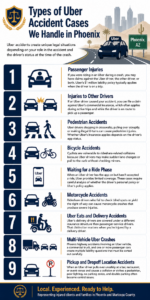
- Passenger injuries. If you were riding in an Uber when it was involved in an accident, you may have claims against the Uber driver, the other driver, or both. Uber’s $1 million liability policy typically applies when the driver is on a trip.
- Injuries to other drivers. If an Uber driver caused your accident, you can file a claim against Uber’s commercial insurance, which provides coverage during active trips and while the driver is en route to pick up a passenger.
- Pedestrian accidents. Uber drivers stopping in crosswalks, pulling over abruptly, or making illegal U-turns have all caused pedestrian injuries in Phoenix. Whether Uber’s insurance applies depends on the driver’s app status.
- Bicycle accidents. Cyclists are particularly vulnerable to rideshare-related collisions because of Uber drivers’ tendency to make sudden lane changes and pull to the curb without checking mirrors.

- Accidents during the “waiting for a ride” phase. When an Uber driver has the app on but hasn’t accepted a ride, Uber provides limited coverage. These cases require careful analysis to determine whether the driver’s personal auto insurance or Uber’s policy applies.
- Motorcycle accidents. Rideshare drivers who fail to check blind spots or yield the right of way cause motorcycle crashes that produce severe injuries.
- Uber Eats and delivery accidents. Uber’s delivery drivers are covered under a different insurance structure than passenger-service drivers. The distinction matters when you’re injured by a delivery driver.
- Multi-vehicle Uber crashes. Phoenix highway accidents involving an Uber vehicle, a commercial truck, and one or more passenger cars create multiple liability questions that we sort out for our clients.
- Accidents at pickup and dropoff locations. When an Uber driver pulls over unsafely at a bar, restaurant, or event venue in Phoenix and causes a collision or strikes a pedestrian, the circumstances of the stop become central to the claim. Poor lighting, no-parking zones, and double-parking all contribute to these accidents.

Phoenix Uber Accident Infographic
Arizona Legal Requirements for Uber Accident Cases
Uber accident claims in Arizona are governed by a combination of state insurance law, personal injury statutes, and rideshare-specific regulations.
Arizona requires rideshare companies to carry specific levels of insurance based on the driver’s activity. When the app is off, only the driver’s personal policy applies. When the app is on but no ride has been accepted, Uber provides limited liability coverage. Once a ride is accepted and through the end of the trip, Uber’s $1 million commercial policy kicks in. These rideshare insurance rules directly affect how your claim is handled and what compensation is available.
The statute of limitations remains two years for personal injury under A.R.S. § 12-542. Comparative negligence under A.R.S. § 12-2505 applies in Uber cases just as it does in any vehicle accident, so your recovery is reduced by any fault attributed to you.
Uber’s liability is a question that depends on the facts of each case. The company classifies drivers as independent contractors, not employees, and uses that classification to distance itself from responsibility. Arizona law and the specific circumstances of the crash determine whether that argument holds.
One complicating factor in Uber accident claims is preserving evidence. Trip data, GPS records, and driver communication logs are all maintained by Uber, and that data can be overwritten or become unavailable if a claim isn’t initiated promptly. We send preservation demands early in the case to make sure that evidence remains intact. In Phoenix, where Uber operates at scale and has even tested autonomous vehicles, these cases arise frequently and require an attorney who stays current on the evolving legal landscape around transportation network companies.
What Damages Are Recoverable in a Phoenix Uber Accident?
The damages available in an Uber accident case are the same as in any personal injury claim in Arizona, but the source of payment may involve multiple insurance policies.
Economic damages cover medical bills, lost income, and other financial losses tied to the accident. If your injuries are serious enough to require surgery, extended rehabilitation, or ongoing treatment, those future costs are included. Property damage to your vehicle, if you were driving, is also compensable.
Non-economic damages include pain and suffering, emotional distress, and the ways the injury has affected your daily life and activities. Arizona places no cap on these damages, so the amount depends on the specific impact the accident has had on you.
Punitive damages may be available if the Uber driver was under the influence, driving recklessly, or violating traffic laws in a way that shows a conscious disregard for the safety of others. In some cases, Uber itself may face scrutiny for its driver vetting and safety practices.
Because multiple insurance policies may be in play, an Uber accident claim in Phoenix can take longer to resolve than a standard car accident case. The driver’s personal insurer, Uber’s commercial insurer, and potentially a third party’s insurance all have to be coordinated. Settlement delays are common, and each insurer will try to shift responsibility to the others. We handle that coordination and make sure every policy that should contribute actually does. Many Uber accident victims in Phoenix also worry about how a claim will affect their own insurance rates. A hit-and-run scenario involving a rideshare vehicle is one example where this concern arises, and we can walk you through how filing a claim may or may not impact your premiums.
Wyatt Injury Law Personal Injury Lawyers, Phoenix Uber Accident Lawyer
5333 N 7th St Suite A-210, Phoenix, AZ 85014
Contact Wyatt Injury Law Personal Injury Lawyers
Uber accident cases move quickly. The company has its own claims process, its own adjusters, and its own interests to protect. You need someone on your side who understands how these cases work and who has the experience to push back when the initial offer falls short.
Contact us today. Wyatt Injury Law Personal Injury Lawyers will review the details of your rideshare accident and tell you where you stand.
Meet Phoenix Uber Accident Lawyer Justin L. Wyatt
 For more than ten years, attorney Justin L. Wyatt has guided injured Arizonans through some of the most complex personal injury claims, including rideshare accidents involving Uber and Lyft. He founded Wyatt Injury Law Personal Injury Lawyers to deliver the kind of attentive, results-oriented advocacy that rideshare collision victims need when navigating layered insurance policies and corporate legal teams. Justin received his undergraduate degree from Brigham Young University – Idaho before earning his Juris Doctorate from the Sandra Day O’Connor College of Law at Arizona State University, where he graduated with high pro-bono distinction. He was also among the few law students to successfully pass the Arizona Bar Exam before completing his degree, an accomplishment that speaks to his discipline and capacity to handle demanding work. In every Uber accident claim he takes on, Justin focuses on identifying every available source of coverage and pursuing the maximum recovery his client is entitled to.
Justin maintains active memberships with the Arizona State Bar, the Maricopa County Bar Association, the Arizona Association for Justice, the Arizona Trial Lawyers Association, and the American Association for Justice. Service to the broader Phoenix community matters deeply to him, and he frequently volunteers with non-profits and charitable causes throughout the Valley. When he is not in the office, Justin spends his time with his wife and three children, enjoying outdoor adventures, travel, sports, and BBQ.
Helpful Resources When Searching for a Phoenix Uber Accident Lawyer
Rideshare accidents involve multiple parties — the driver, Uber, and their insurers — making these cases more complex than a standard car crash. Read through these articles to understand how liability and compensation work in Arizona Uber accident claims.
- Is Uber Responsible for Accidents? Whether Uber can be held liable depends largely on what the driver was doing at the time of the accident. This article explains the different coverage phases and when Uber’s insurance applies.
- Arizona Rideshare Insurance Requirements Arizona has specific laws governing how rideshare companies must insure their drivers — and those rules directly affect how much compensation you can recover. Learn what coverage is required and how it works.
- Phoenix Uber Accident Damages Explained Uber accident victims may be entitled to compensation for medical bills, lost wages, pain and suffering, and more. This post walks through the types of damages available in Phoenix rideshare claims.
- Arizona Rental Car Insurance Laws If you were riding in a rented vehicle or the Uber driver was using one, insurance questions get even more complicated. This article clarifies how rental car coverage works under Arizona law.