
Catastrophic Lawyer Phoenix, AZ
If you suffered a catastrophic injury, your legal case is fundamentally different from standard personal injury claims. The damages don’t end when the hospital stay does. They extend over a lifetime: ongoing medical care, adaptive equipment, home modifications, lost earning capacity for decades, and the full human cost of a life irrevocably altered by someone else’s negligence.
Our Phoenix, AZ catastrophic lawyer at Wyatt Injury Law Personal Injury Lawyers fights for full lifetime compensation, not just immediate medical costs. Founding attorney Justin L. Wyatt has spent over 10 years handling serious injury claims in Arizona, exclusively on the plaintiff’s side.
Why Choose Wyatt Injury Law Personal Injury Lawyers for Catastrophic Cases in Phoenix, AZ?
Valuing Cases the Right Way
The difference between a fair result and a devastating one in a catastrophic case often comes down to how completely the long-term damages are built and documented. The cost of permanent disability, calculated honestly over a lifetime, is often many times larger than what an insurer offers early in a case.
Our firm has recovered millions of dollars for injured clients across Arizona, including $3,195,000 in a serious sideswipe and construction defect case, $1,300,000 for a motorcycle injury victim, and $950,000 and $854,500 in high-impact rear-end collision cases. These results reflect an approach that begins with the full picture of what a serious injury costs over time, not the insurer’s opening number.
Experience and Credentials That Matter
Justin L. Wyatt earned a Top 10 Jury Verdict recognition from the National Trial Lawyers Association in 2021 and has practiced personal injury law in Phoenix for over a decade after graduating from Sandra Day O’Connor College of Law at Arizona State University. He is admitted to all Arizona courts and the United States District Court for the District of Arizona, and is a member of the Arizona Association for Justice, the Maricopa County Bar Association, and the American Bar Association.
Support Through a Difficult Process
Catastrophic cases take time, involve complex expert testimony, and require clients to relive and document the full scope of their loss. Families navigating permanent disability alongside a legal claim deserve direct attorney involvement and clear communication throughout. That’s what we provide.
⭐⭐⭐⭐⭐
“Justin was a blessing to my family during a very difficult time. He took the time to explain everything and fought hard to get us the best result possible.” — Heather Park
Read more reviews on our Google Business Profile.
No Fee Unless We Win
We handle catastrophic cases on contingency. Our fee is a percentage of the recovery, paid when we win. If we don’t recover money for you, you owe nothing, regardless of how much time and work went into the case.
Types of Catastrophic Cases We Handle in Phoenix
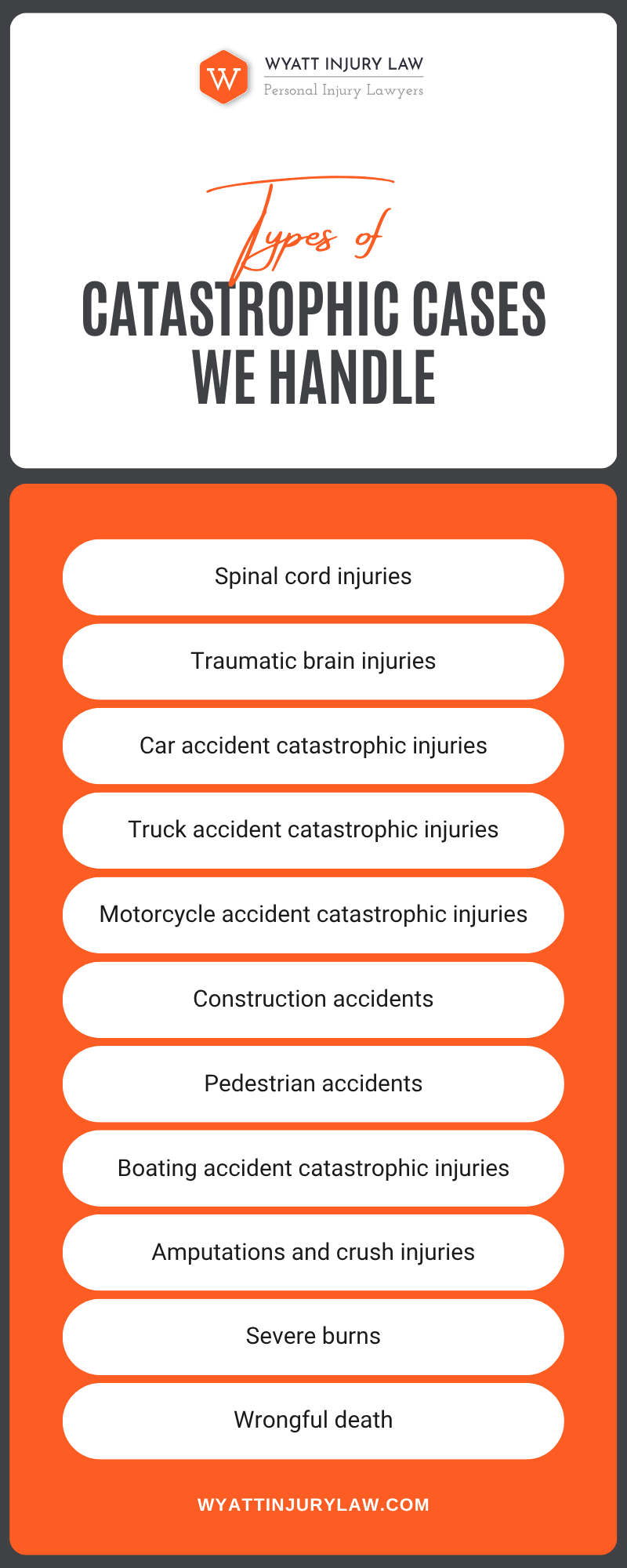
 Catastrophic injuries arise from many different types of accidents. What defines them is not the cause but the consequence: permanent, life-altering harm that changes what the injured person can do, earn, and experience for the rest of their life. We handle catastrophic claims arising from the following throughout Phoenix and Maricopa County.
- Spinal cord injuries. Complete or incomplete spinal cord damage resulting in paralysis, whether paraplegia, quadriplegia, or partial loss of motor and sensory function, is among the most life-altering injury types in personal injury law. Lifetime care costs for spinal cord injury can reach into the millions.
- Traumatic brain injuries. Severe TBI can permanently alter cognition, personality, memory, and the ability to work or live independently. TBI cases require specialized medical evidence and careful documentation of how the injury has changed the person’s functional capacity, not just their diagnosis.
- Car accident catastrophic injuries. High-speed crashes, T-bone collisions, and rollover accidents are among the most common causes of catastrophic injury in Phoenix. Vehicle crashes that produce spinal, brain, or internal organ damage require a fundamentally different damages approach than standard car accident claims.
- Truck accident catastrophic injuries. The force differential between a loaded commercial truck and a passenger vehicle means that serious injury is the norm, not the exception, in significant truck crashes. Spinal cord damage, severe traumatic brain injury, and crush injuries are frequent outcomes.
- Motorcycle accident catastrophic injuries. Riders have no protection in a serious crash. Road rash requiring skin grafting, spinal injuries, amputations, and severe head trauma are documented outcomes in high-impact motorcycle crashes.
- Construction accidents. Falls from height, crush injuries, electrical accidents, and caught-in incidents produce some of the most severe injuries in any industry. Construction catastrophic cases frequently involve both workers’ compensation and third-party liability claims.
- Pedestrian accidents. A pedestrian struck by a vehicle at speed has virtually no protection. Spinal cord injuries, traumatic brain injuries, and multiple orthopedic fractures are common outcomes in serious pedestrian accidents.
- Boating accident catastrophic injuries. Propeller strikes, high-speed collisions, and ejection from watercraft produce catastrophic injury at rates far disproportionate to the activity’s popularity. These cases involve both Arizona boating statutes and, in some circumstances, federal maritime law.
- Amputations and crush injuries. Loss of a limb, whether from the accident itself or as a surgical consequence, changes every aspect of a person’s life. Prosthetics, adaptive equipment, vocational retraining, and the permanent loss of function must all be accounted for in the damages.
- Severe burns. Serious burn injuries from vehicle fires, construction accidents, and product failures require extensive surgical treatment, long-term rehabilitation, and often produce permanent disfigurement. The lifetime medical and psychological costs of severe burns are among the highest of any injury type.
- Wrongful death. When catastrophic injuries prove fatal, whether immediately or as a result of complications, the family’s claim transitions from personal injury to wrongful death. We handle both components when the facts require it.
Arizona Legal Framework for Catastrophic Claims
No Cap on Compensatory Damages. Arizona imposes no statutory cap on compensatory damages in personal injury cases. In catastrophic cases, where lifetime medical costs, lost earning capacity, and non-economic damages can collectively reach into the millions, that matters enormously. Arizona’s approach to catastrophic injuries provides the legal framework for pursuing full compensation.
Comparative Fault, A.R.S. § 12-2505. Arizona’s pure comparative fault rule applies in catastrophic cases. Defense teams argue contributory fault aggressively in high-value cases because even a 20% fault assignment on a multi-million dollar claim represents a significant reduction. Knowing how to build the record against these arguments is central to how we prepare every catastrophic case. The full statute is at A.R.S. § 12-2505.
Product Liability, A.R.S. § 12-681. When a defective product, such as a vehicle component, safety equipment, or industrial machinery, caused or contributed to a catastrophic injury, a product liability claim may exist against the manufacturer, distributor, or seller under Arizona law. Arizona’s product liability framework under A.R.S. § 12-681 allows recovery for both manufacturing defects and design defects. These claims can be pursued alongside negligence claims and, in cases of egregious conduct, may support punitive damages.
Dram Shop Liability, A.R.S. § 4-311. When a catastrophic injury was caused by an impaired driver who was served alcohol by a bar, restaurant, or other licensed establishment, Arizona’s dram shop statute may provide an additional source of liability and recovery. In high-damage cases where the at-fault driver has limited insurance, dram shop claims against commercial establishments can be critical to full compensation. The statute is at A.R.S. § 4-311.
Statute of Limitations, A.R.S. § 12-542. Two years from the date of injury to file a personal injury claim. Government entity involvement requires pre-suit notice within 180 days under A.R.S. § 12-821.01. In catastrophic cases, early legal involvement also protects evidence and allows time to retain the expert witnesses, including life care planners, vocational economists, and medical specialists, that these cases require. The Arizona statute of limitations is a hard deadline. The full statute is at A.R.S. § 12-542.
What Damages Are Recoverable in a Phoenix Catastrophic Case?
The damages available in catastrophic cases reflect compensation across an entire lifetime rather than just until the medical bills stop arriving.
Consider what permanent spinal cord injury actually costs. The National Spinal Cord Injury Statistical Center estimates lifetime care costs ranging from $1.2 million to over $5 million depending on injury severity and age at injury. That figure includes medical care, but it also includes home modifications, adaptive vehicles, personal care attendants, and the dozens of other expenses that come with permanent paralysis.
Lost earning capacity is calculated by comparing what the injured person would have earned over their remaining working life to what they can now earn. The calculation requires vocational and economic experts who can project earnings, account for promotions and career growth, and discount future losses to present value.
The human cost of catastrophic injury is impossible to quantify, but Arizona law requires juries to try. Pain and suffering in these cases is an ongoing condition. The physical pain of paralysis, the psychological weight of permanent disability, the relationships strained or ended, the activities forever foreclosed. Depression, anxiety, and PTSD are documented in the majority of catastrophic injury cases. These are compensable harms, and in the most serious cases, they can equal or exceed the economic damages.
When the defendant’s conduct was egregiously reckless, punitive damages may also apply. These are rare but significant when warranted. Arizona places no cap on compensatory damages in personal injury cases.
What Steps Should I Take After a Catastrophic Injury in Phoenix?

1. Focus on emergency medical care. Catastrophic injuries require immediate, specialized treatment. Trauma centers, neurosurgeons, and intensive care units exist for exactly these situations. Everything else, including the legal process, comes after stabilization.
2. Document everything from the beginning. Even while hospitalized, family members can photograph the scene, preserve the injured person’s clothing and equipment, and note the names of witnesses. Evidence in catastrophic cases is critical, and some of it disappears quickly.
3. Do not speak with any insurer other than your own. The at-fault party’s insurance company will contact you, sometimes within days of a catastrophic injury. They are not gathering information to help you. They are building a case to minimize what they pay. Do not give a recorded statement. Do not sign anything.
4. Keep every medical record and bill. Catastrophic cases involve extensive documentation. Medical records, imaging, surgical notes, rehabilitation reports, prescription records, and equipment invoices all factor into the damages calculation. Organize everything from the start.
5. Identify all potentially liable parties. Catastrophic injuries often involve multiple defendants. The driver, the vehicle manufacturer, the trucking company, the property owner, the contractor. Each potential defendant represents a potential source of recovery.
6. Contact a Phoenix catastrophic lawyer immediately. These cases require early expert involvement, evidence preservation, and strategic planning that standard injury claims do not. The sooner legal representation is in place, the stronger the foundation for building a full lifetime damages case.
Catastrophic Injury Statistics in Phoenix and Arizona
Catastrophic injuries are more common than most people realize.
The National Institute of Neurological Disorders and Stroke reports that traumatic brain injury contributes to approximately 190 deaths per day in the United States, with survivors often facing permanent functional impairment. Unintentional injuries are the leading cause of death for Americans ages 1 to 44 and a leading cause of permanent disability across all age groups.
Spinal cord injuries affect an estimated 18,000 Americans annually, according to the National Spinal Cord Injury Statistical Center. Vehicle crashes are the leading cause, accounting for approximately 38% of all new spinal cord injury cases nationally. In Arizona, where high-speed road design and significant commercial vehicle traffic are constants, the exposure is documented.
The Arizona Department of Transportation crash data shows that incapacitating injuries occur at significant rates on Maricopa County roads each year. Phoenix’s combination of high-speed arterials, heavy freeway traffic, and one of the highest pedestrian fatality rates in the country creates consistent catastrophic injury exposure.
Construction remains one of the most dangerous industries in Arizona. The Bureau of Labor Statistics tracks workplace fatalities, and OSHA identifies falls as the single leading cause of construction fatalities. Along with electrical accidents and struck-by incidents, they account for the majority of catastrophic construction injuries we handle.
Phoenix Catastrophic Injury Infographic
Phoenix Catastrophic Lawyer FAQs
 What makes a catastrophic case different from a standard injury claim?
 What makes a catastrophic case different from a standard injury claim?
The permanence and scope of the damages. A broken arm heals. A severed spinal cord does not. Catastrophic cases require projecting damages over a lifetime, including future medical costs, lost earning capacity, and non-economic losses that extend for decades. They require expert witnesses such as life care planners, vocational economists, and medical specialists. And they require an attorney who knows how to build and present that evidence persuasively.
What is a life care plan and why does it matter?
A life care plan is a detailed projection of all future medical and support costs associated with a permanent injury, prepared by a certified life care planner working with the treating medical team. It documents the cost of every anticipated medical need over the injured person’s expected lifetime: surgeries, medications, therapy, equipment, home care, and facility care if needed. In catastrophic cases, the life care plan is often the single most important document in the damages case.
How is lost earning capacity calculated in a catastrophic case?
By a vocational rehabilitation specialist and an economic expert working together. The vocational expert assesses what work the injured person can and cannot perform given the permanent limitations of their injury. The economic expert projects the dollar difference between what the person would have earned without the injury versus what they can earn with it, discounted to present value. In cases involving young plaintiffs, this calculation can represent millions of dollars.
What if the insurance policy limits aren’t enough to cover lifetime damages?
We investigate every available source of recovery, including all potentially liable defendants, all applicable insurance policies including umbrella and excess coverage, dram shop liability, product liability, and employer liability where applicable. In catastrophic cases, it is rarely appropriate to treat any single policy as the ceiling of recovery without a thorough investigation of every avenue.
Does Arizona cap what I can recover for a catastrophic injury?
No. Arizona has no statutory cap on compensatory damages in personal injury cases. Punitive damages are available when the defendant’s conduct warrants them.
What if I was partially at fault for the accident that caused my catastrophic injury?
You can still recover under Arizona’s pure comparative fault rule. Your damages are reduced by your percentage of fault, but there is no cutoff. In catastrophic cases, where total damages may be very large, even a significant fault allocation still leaves substantial recovery available.
How long does a catastrophic case take?
Longer than most. The medical picture needs to stabilize before lifetime damages can be accurately projected, and that can take a year or more after a serious injury. Building the expert case, completing discovery, and negotiating or litigating against well-funded defendants takes additional time. Two to four years from injury to resolution is not unusual in serious catastrophic cases. The factors that delay settlements are often amplified in these cases.
Should I settle before I reach maximum medical improvement?
Generally no. Before maximum medical improvement, the full scope of permanent limitations and lifetime care needs is not yet established. Settling early means accepting a number built on incomplete information, and once you sign a release, the claim is permanently closed regardless of how your condition evolves. Understanding what a reasonable settlement offer looks like applies with particular force in catastrophic cases.
What does a catastrophic lawyer in Phoenix cost?
Nothing upfront. We work on contingency, meaning our fee is a percentage of what we recover, paid only when we win. If we don’t recover money for you, you owe nothing.
Important Local Resources for Phoenix Catastrophic Injury Victims
 The following resources may be useful to catastrophic injury victims and families in the Phoenix area. Their inclusion is for informational purposes only and does not constitute an endorsement by Wyatt Injury Law Personal Injury Lawyers.
- Barrow Neurological Institute – (602) 406-3000. One of the world’s leading neurological centers, located in Phoenix, with specialized programs for traumatic brain injury, spinal cord injury, and complex neurological rehabilitation.
- Banner University Medical Center Phoenix – (602) 747-4000. Level I trauma center serving the Phoenix metro with full trauma surgery capabilities.
- United Spinal Association – National nonprofit providing peer support, resources, and advocacy for spinal cord injury and disease survivors.
- Arizona Center for Disability Law – (602) 274-6287. Nonprofit legal advocacy organization serving Arizonans with disabilities, including those acquired through catastrophic injury.
- National Spinal Cord Injury Statistical Center – Research and lifetime cost data for spinal cord injury, including projections directly relevant to legal damages analysis.
- Arizona DES Vocational Rehabilitation – (800) 563-1221. State vocational rehabilitation services for individuals with disabilities seeking return-to-work support after catastrophic injury.
- Maricopa County Superior Court – (602) 506-3204. For civil litigation filings and court information.
Wyatt Injury Law Personal Injury Lawyers does not endorse and has no affiliation with any of the resources listed above. This information is provided as a public service.
Contact Wyatt Injury Law Personal Injury Lawyers
Catastrophic injuries require a legal approach built around lifetime damages, supported by expert evidence, and pursued by an attorney who understands that early settlement offers are designed to close cases cheaply rather than compensate fully.
Wyatt Injury Law Personal Injury Lawyers represents catastrophic injury victims and families throughout Phoenix and the greater Arizona area. We work on contingency, and we collect no fee unless we win your case. If you or a family member suffered a catastrophic injury, contact us for a free consultation. We will review the facts directly and provide an honest assessment of what full compensation looks like.